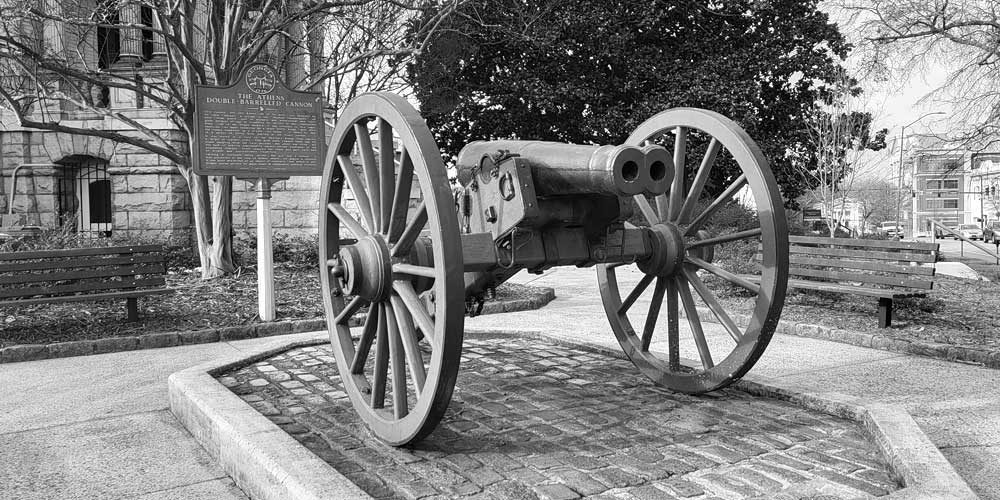
Gilleland’s Double-Barreled Cannon: an excerpt from Haunts & Hollows: Georgia Backroads.
Founded in 1850 as the Athens Steam Company, the Athens Foundry & Machine Works reopened under new management in 1854. The new enterprise focused on larger scale metal projects, including the now-famous Arch of the University of Georgia. As the Civil War cut the South off from its northern suppliers, the Foundry became a critical resource for manufacturing the many goods and luxuries required by 19th century lifestyles.
The mill went down in military history in 1862 when Georgia dentist John Gilleland raised $350 from local Confederate sympathizers to build his design for a chain-shot cannon. The idea, which has its roots as far back as 17th century Florence, was to manufacture a double-barreled cannon. Each barrel would simultaneously fire a 3-inch ball, and the balls would be connected by a length of chain. The weapon intended to do catastrophic damage to the enemy line, the chain mowing down advancing soldiers like a scythe through wheat.
Fortunately (for the North), the design was a dismal failure. To succeed, the barrels had to fire at the exact same instant, a detail that wasn’t possible with 1860’s technology. The slightest difference in firing times would send the balls flying off course. On April 22, 1862, the inventor’s machine test-fired three times. The results were spectacular yet unintentional. In only three shots, the cannon mowed down several pine trees, destroyed a swath of cornfield, knocked down a chimney, and killing a nearby cow—none of which had been intended targets.
While John was enthusiastic about his perceived success, the Southern army was less so. He brought the contraption to the Confederate States Army’s arsenal in nearby Augusta, but the command felt it was too dangerous for combat. In the end, the cannon returned to Athens. It fired in battle only once on July 27, 1864, and then only without the connecting chain. It disappeared in 1891 before resurfacing in 1904. Today it sits on the front lawn of Athens’ City Hall.